

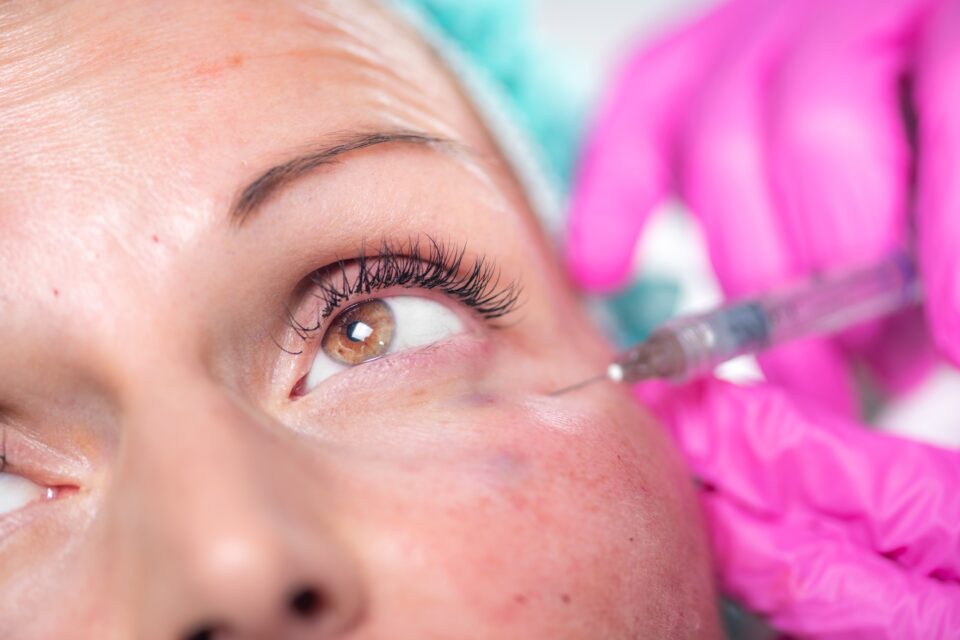
Injectable polynucleotides have attracted growing attention for delicate periorbital skin. A systematic review published in Aesthetic Surgery Journal Open Forum evaluates their efficacy and safety for rejuvenation around the eyes. The authors frame the clinical problem as a combination of dynamic wrinkles, volume change and deterioration in dermal quality—features that do not necessarily respond to one treatment in the same way.
What a systematic review can tell us
A systematic review identifies and evaluates existing studies, but its conclusions are only as robust as the underlying evidence. Differences in formulation, injection technique, treatment schedules, participant selection and assessment tools can make findings difficult to compare. An apparent improvement in skin texture does not establish an equivalent effect on tear-trough hollowing, pigmentation or true skin laxity.
Practical questions for patients
The periorbital region is anatomically sensitive. Swelling, bruising and other injection-related complications matter, and not all products marketed as polynucleotides have identical compositions or regulatory status. Patients should ask what product is being used, what indication it is authorized for locally, what realistic outcome is expected and how complications would be managed.
Where caution is needed
The review supports examining this category scientifically rather than relying on social-media before-and-after images. The accessible indexed record confirms the publication and review topic, but precise pooled response rates or complication percentages were not independently established for this article. Claims that polynucleotides are definitively superior to hyaluronic acid fillers, lasers or other approaches would require direct comparative evidence.
An important correction changes the interpretation of this review. The largest included trial, involving 215 analysed participants, was retracted in March 2026. The retraction notice says that one filler was misidentified and that this undermined the reliability of the results. The systematic review’s reference list now identifies the trial as retracted, yet the published synthesis still discusses its findings.
The timing is important. The review’s search ended in January 2026. The retraction followed in March, and the review appeared online in October. A review is not automatically invalid because one study was withdrawn. However, its pooled or narrative conclusions need reassessment when a large share of the underlying evidence changes status.
The remaining studies are smaller, and follow-up did not extend beyond six months. They cannot establish long-term safety or prove superiority over other injectable products. Moreover, studies in specific populations may not transfer directly to every patient group or skin type.
This is a research-integrity story as well as an aesthetics story. Readers should be able to distinguish the original authors’ conclusions from the strength of the evidence after a retraction. The authors and journal may be able to clarify whether a revised analysis is planned and how the retraction affects the conclusions.
Original source
https://doi.org/10.1093/asjof/ojag200
Medical information disclaimer
This article is published by Aesthetics.news for general information and educational purposes only. It does not constitute medical advice, diagnosis or treatment, and should not replace a consultation with a qualified healthcare professional. Treatments and outcomes may vary from person to person. Readers should seek advice from an appropriately qualified professional before making decisions about their health or treatment. In a medical emergency, seek immediate medical assistance.